Enterprise Architecture
Understanding Modern Software Architecture: Choosing the Right Pattern for the Right Problem
There is no single 'best' architecture, only the right pattern for the problem in front of you. This guide breaks down ten proven architecture patterns and when each one earns its complexity.
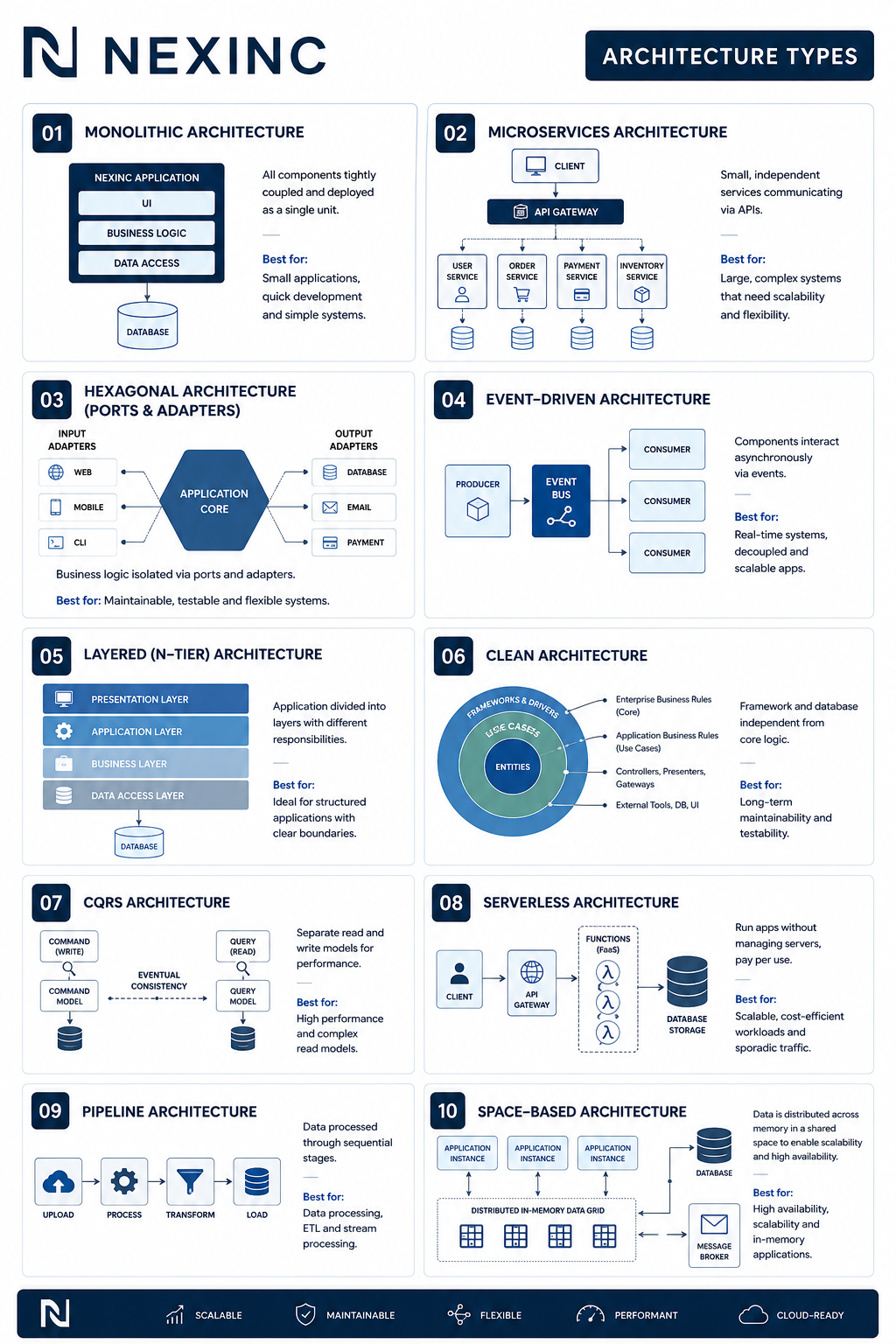
Software architecture is much more than writing clean code. It is about designing systems that are scalable, maintainable, resilient, and aligned with business goals.
There is no single "best" architecture. Each pattern solves a different problem, and choosing the right one depends on your application's size, complexity, scalability needs, and operational requirements.
Here are the ten architecture patterns that show up most often in modern software engineering, what each one is good at, and where it breaks down.
1. Monolithic Architecture
A monolithic architecture packages the entire application into a single deployable unit. The user interface, business logic, and data access layers all live inside one codebase and deploy together.
Strengths: simple to build and deploy, easier debugging, lower operational overhead, and a fast path from idea to working product.
Trade-offs: individual components are hard to scale independently, the whole application has to be redeployed for small changes, and the codebase becomes harder to maintain as it grows.
Best suited for: internal business applications, proofs of concept, small teams, and early-stage MVPs.
2. Microservices Architecture
Microservices break a system into independently deployable services, each responsible for a specific business capability. A client talks to an API gateway, which routes requests to services such as user, order, payment, or inventory, and each service typically owns its own database.
Strengths: independent deployments and scaling, technology flexibility per service, team autonomy, and fault isolation when one service fails.
Trade-offs: operational complexity, distributed transactions, network latency, and the need for reliable service discovery.
Best suited for: enterprise platforms, SaaS products, high-growth systems, and large engineering teams.
3. Hexagonal Architecture (Ports and Adapters)
Hexagonal architecture isolates business logic from external technologies. Business rules never depend directly on databases, APIs, or frameworks; instead, adapters sit on the boundary and translate between the outside world and the application core.
Strengths: highly testable, framework independent, and easy to swap external systems without touching core logic.
Trade-offs: more abstraction and somewhat higher upfront development effort.
Best suited for: domain-driven applications, and regulated domains such as banking and healthcare.
4. Event-Driven Architecture (EDA)
Instead of services calling each other directly, components exchange events asynchronously through an event bus. When an order is created, for example, inventory, billing, and shipping services can each react independently, without knowing about one another.
Strengths: loose coupling, high scalability, real-time processing, and strong resilience since a failure in one consumer does not block the others.
Trade-offs: eventual consistency, event ordering challenges, and harder debugging across distributed flows.
Best suited for: financial systems, IoT, retail, logistics, and real-time analytics.
5. Layered (N-Tier) Architecture
One of the oldest and most common architectural styles. A typical stack separates presentation, application, business, and data access layers on top of a database, with each layer responsible for one concern.
Strengths: simple, easy to understand, and gives a clear separation of concerns.
Trade-offs: performance overhead from passing through layers, and it is difficult to evolve into a distributed system later.
Best suited for: enterprise applications, government systems, and traditional line-of-business software.
6. Clean Architecture
Popularized by Robert C. Martin, Clean Architecture organizes code around business use cases rather than frameworks. Dependencies always point inward, from frameworks and adapters, through use cases, to entities at the core.
Strengths: extremely maintainable, highly testable, and framework independent over the long life of a product.
Trade-offs: more initial design effort, and it can feel like overkill on small projects.
Best suited for: enterprise applications, long-lived products, and large development teams.
7. CQRS (Command Query Responsibility Segregation)
CQRS separates write operations from read operations instead of relying on a single model for both. Commands flow to a write model, queries flow to a read model, and each side can be optimized independently.
Strengths: better performance, optimized reporting, easier scaling, and it pairs well with event sourcing.
Trade-offs: more complexity, eventual consistency between the write and read sides, and additional infrastructure to maintain.
Best suited for: financial platforms, high-volume systems, and applications with complex reporting needs.
8. Serverless Architecture
Developers write functions while the cloud provider manages the infrastructure. A typical flow runs from client, through an API gateway, into functions, and out to a database, with the platform handling scaling automatically.
Strengths: no server management, automatic scaling, pay-only-for-usage pricing, and rapid development.
Trade-offs: cold starts, vendor lock-in, and limits on execution time.
Best suited for: APIs, background jobs, event processing, and startups moving quickly.
9. Pipeline Architecture
Data flows through a sequence of processing stages, typically upload, process, transform, and load, with each stage owning one responsibility.
Strengths: modular processing, easy to extend with new stages, highly scalable, and fault isolation between stages.
Trade-offs: data orchestration complexity, and monitoring pipeline failures across stages.
Best suited for: ETL, data engineering, AI pipelines, and stream processing.
10. Space-Based Architecture
Space-based architecture is designed to eliminate database bottlenecks by storing data across a distributed in-memory grid rather than relying on one central database. Most reads and writes happen in memory across application instances, with the database used for durability.
Strengths: extremely high throughput, massive scalability, high availability, and low latency.
Trade-offs: complex implementation, and data synchronization overhead across the grid.
Best suited for: high-frequency trading, telecommunications, gaming platforms, and large-scale SaaS applications.
Which Architecture Should You Choose?
- Monolithic – MVPs, startups, internal tools
- Microservices – enterprise platforms, SaaS
- Hexagonal – domain-centric applications
- Event-Driven – real-time and distributed systems
- Layered – traditional enterprise software
- Clean – long-term maintainable applications
- CQRS – high-performance transactional systems
- Serverless – cloud-native APIs and event processing
- Pipeline – ETL, AI, and analytics workloads
- Space-Based – ultra-high scalability and low latency
Final Thoughts
A common misconception is that one architecture replaces another. In reality, modern enterprise systems usually combine several patterns at once.
A cloud-native e-commerce platform, for example, might use microservices to separate business capabilities, hexagonal architecture within each service to isolate business logic, clean architecture for maintainable code organization, event-driven architecture for order processing and inventory updates, CQRS for high-volume reads and writes, serverless for image processing and notifications, and pipeline architecture for analytics and AI model training.
The role of an architect is not to choose the most popular pattern. It is to choose the right architecture for the business problem, balancing scalability, maintainability, performance, cost, and team maturity.
Getting this right starts with a clear enterprise architecture foundation and a realistic view of why architecture projects fail when that discipline is skipped.
Frequently Asked Questions About Software Architecture Patterns
What is the most scalable software architecture pattern?
Microservices, event-driven architecture, and space-based architecture all support very high scalability, but the right choice depends on whether your bottleneck is organizational (many teams shipping independently), data-flow related (asynchronous, high-volume events), or database throughput under extreme load.
Can you combine multiple architecture patterns in one system?
Yes. Most mature enterprise systems combine patterns, for example microservices at the system level, hexagonal architecture inside each service, and event-driven communication between services. Patterns are complementary tools, not mutually exclusive choices.
How do I choose between monolithic and microservices architecture?
Start with a monolith if you have a small team, an unproven product, or tight timelines, since it is faster to build and easier to operate. Move toward microservices once the team, the codebase, or the scaling needs outgrow what a single deployable unit can support.